
Recovering CIA Article 131 – The Archangel by Author TD Barnes
- By tdbarnes
 The Recovery of Article 131, Mission BX-6727 over North Vietnam flown by Frank Murray on 6 October 1967.
The CIA’s operational phase of its Area 51 Project OXCART, codenamed Operation BLACK SHIELD, called for the A-12 operating out of the Kadena Air Force Base in Okinawa. The first phase staged three aircraft from Area 51 to Okinawa for 60-day periods, twice a year, with about 225 personnel involved.
CIA A-12 Project Pilots Mele Vojvodich, Jack Layton, and Jack Weeks were the first project pilots to rotate from Area 51 to Kadena. Frank Murray, Ken Collins, and Dennis Sullivan remained at Area 51, where they continued enough training flights to maintain their currency until they took their turn at Kadena.
At 0100 hours, ZULU, on 6 October 1967, Frank Murray, Dutch 20, departed the Kadena AB, flying A-12 Article 131 on BLACK SHIELD mission BX6727, a single-pass reconnaissance mission flown over North Vietnam, flying the previously canceled Mission BX 6726.
A typical route profile for a BLACK SHIELD mission over North Vietnam included a refueling shortly after taking off, south of Okinawa, accomplishing a planned photographic pass, withdrawing to a second aerial refueling in the Thailand area, and returning to Kadena.
Murray’s photography gave no evidence of surface-to-surface missile facilities or equipment. Overall, he recovered good photography despite scattered clouds covering approximately 40 percent of the target area. His single-pass mission photographed thirty-six COMIREX targets, nine of them SA-2 sites with undetermined occupancy.
Murray’s System 6 tapes recorded seven Fan Song signals during the mission overflight. None of these signals appeared to be tracking the vehicle and activated no onboard defensive systems because of these signals.
At 0128 hours, ZULU, the surface-to-air missile battalion at VN 142, received an alert of an approaching A-12. The warning message, “Be ready to do battle,” arrived 51 minutes before the initial detection of Murray’s flight by Chinese radar facilities. (The CIA acted to determine the source of this forewarning, but results were negative. Such a warning was significant because it provided the North Vietnamese with ample time to prepare · whatever defenses they might choose to use against the BLACK SHIELD vehicle.) COMINT noted four SAM battalions reacting to Murray’s A-12 aircraft. Murray saw no indication of launch activity by any of them. The mission flight path went well north of these surface-to-air missile sites. Two of the battalions located by COMINT at sites 142 and 148 offset 60 and 65 nautical miles from Murray’s track.
Murray noted both the Chinese and North Vietnamese air defense facilities’ tracking him from 0219 hours to 0253 hours ZULU. Bai Thuong was the first North Vietnamese radar station that had it reporting a track of Murray’s plane intercepted. Bai Thuong detected the vehicle at 0237 hours ZULU at a ground range of 156 nautical miles and continued tracking it out to a range of 172 nautical miles. Three Chinese radar stations — San-pao-chi, Chiang-cheng in China, and Dien Bien Phu in North Vietnam–reported initial detection and final tracking ranges, respectively, of 56-248, 142-29 nautical miles, and 180-64 nautical miles. The tracks and altitudes were in general compatible with those of Murray’s aircraft. During the overflight period, one EB-66C and one EB-66B jamming platforms were active. However, strike activity remained light.
It was after Murray took his photo run that his flight became the CIA’s worst nightmare. Murray had completed his first pass over denied territory when he heard a loud bumping sound and noticed a fluctuation in his right engine’s oil pressure gauge, dropping to zero as he approached 20 miles to INS position 06.
After shutting down the right engine, Murray kept the good engine at max thrust until clearing North Vietnam airspace. He then descended on the intended tanker path. While over Laos, Murray called the tanker on the secure radio, telling the tanker crew that he was aborting the rest of the mission and planned to land at the Takhli Royal Thai Air Force Base in Thailand. Unknown to Murray, Takhli AB was the home of CIA U-2 Detachment G, deployed there in November 1962 at Indian Prime Minister Jawaharlal Nehru’s request to carry out the Chinese-Indian border area overflights following the Sino-Indian War during October–November 1962.
The tanker relayed what he knew back to Kadena, with the abort well underway by now.
Murray arrived overhead at Takhli, where he tried to contact the control tower without success. It was then that the tanker reminded Murray that he was still transmitting in the secure radio mode, which explained his not receiving an answer. After switching to the normal UHF mode, the tower told Murray of an emergency recovery to happen soon, wanting to know what type of airplane was involved, how many souls on board, how much fuel on board, etc., asking the usual things a control tower asks. Murray told the tower operator the airplane type was classified, that he had one soul on board, and the fuel state was about 15,000 lbs. The tower operator asked if the emergency aircraft could hold while the base launched a large strike force.
 Murray told the tower that he was twenty miles out on a straight-in approach. All the while, the base was not visible to Murray due to cloud cover over the base. At about five miles and under the cloud deck, Murray sighted the runway and prepared for a single-engine landing (which for him was not a significant problem). With the gear down, the tower could now see what must have been quite a sight, an A-12 plane approaching the base.
The landing was uneventful, but as Murray cleared the runway on a taxiway, he informed the tower that he’d fowled the runway by the small chute that deployed the main drag-chute and a good number of rubber bands from the deployed drag-chute.
 This unscheduled emergency landing caused a considerable delay in launching a sizeable F-105 strike force bound for North Vietnam. Murray’s tanker also landed as he had the PF-1 fuel needed to service the A-12 for recovery to Kadena.
Stopped on the taxiway, Murray summoned the base commander to discuss what to do and where to put the A-12.
The first officer to come out to the A-12 was the Thai base commander. Murray told the tower to have the American commander come out. An American Air Force colonel did arrive shortly after, and they discussed where to move the A-12.
The unaffected engine was still running, so Murray could move the airplane under its power. The Thai and American commanders decided that the best place was the compass rose parking stand off the main taxiway.
 It was there that Murray gave the American officer his letter of introduction. Shortly after that, a group of people approached the A-12 and identified themselves as CIA people from the U-2 detachment.
Now having knowledgeable assistance, Murray could shut down the engine providing air conditioning to his flight suit. The U-2 guys indicated that they would try to move the A-12 to their hangar as there were no other hangars on the base, only nose docks. They transported Murray to the U-2 compound to remove the pressure suit and make a call to Kadena describing the airplane problems.
Between the U-2 guys and the base, they concocted a tow bar to use in moving the A-12 to the U-2 hangar. The hangar pathway’s design for the U-2 consisted of a single narrow hard surface for the A-12 nose wheel, leaving the main gear off the hard surface. They planned to position PSP planking for the main gear to ride on. Murray remained in the cockpit while the towing operation took place. The airplane’s weight on the nose wheels destroyed the PSP. The U-2 detachment had plenty of PSP, so they continued to the hangar.
The U-2 hangar was sufficiently wide to house the A-12 but marginally suited in height. As the A-12 approached the hangar, it became clear that the rudders would strike the top of the hangar doorway. After much discussion about how to proceed, they decided to deflate the main gear struts to gain clearance for the rudders. This action worked, and the A-12 was now securely in the hangar with the doors shut to prevent prying eyes from watching what went on. The U-2 detachment people downloaded the camera and removed the film (take) for processing. Murray borrowed a flying suit from the U-2 guys and awaited the recovery team.
At the first indication of an abort, extending from Kadena Air Base to CIA Headquarters at Langley, a mad scramble had erupted to get Murray to safety and protect the mission’s integrity. Protecting the secrecy of the A-12 was a prime concern. An unknown station had compromised call signs, requiring new call signs for A-12 buddy recovery by Detachment 4 commo. A recovery team of 9 officers, eight enlisted, 33 civilians, and 4000 lbs of equipment was loaded on a KC-135 to join Murray and the plane. A C-130 with 24,800 lbs equipment and two civilians followed. The trip took 4 hours 11 minutes.
 Unable to repair the broken link to an oil pressure sensor, the Pratt & Whitney engineer ran a wire through a panel door to provide operational oil pressure information. The improvised repair restricted the flight to low speed, which created all sorts of problems, exposing the Oxcart vehicle to unauthorized viewing and rapidly deteriorating weather conditions.
After completing the repairs in the U-2 hangar, the CIA moved the A-12 outdoors back to the compass rose parking stand. The weak taxiway became a problem as it wasn’t strong enough for the plane to return to the hangar once loaded with fuel. In the event of a delayed takeoff, the ground crew would cover the plane with tarps after servicing.
The ground crew did an engine start to check on their work. All went well, so the CIA planned for the flight to Kadena. Part of the preparation was the alignment and loading of the INS route to the home base at Kadena. The INS crew did not have a good benchmark position to load (present location), so they used the Takhli AB base-ops’ position furnished by the base.
Usually, the A-12 would have been ground run on a tie-down before released for flight, but there was no sufficient tie-down for the A-12, so the recovery team decided on Murray testing the engine on takeoff.
The two SAC 903rd KC-135s on station made it possible to organize a return buddy flight. However, the recovery equipment brought up in C-130 was too large to fit in a KC-135 for return to Kadena.
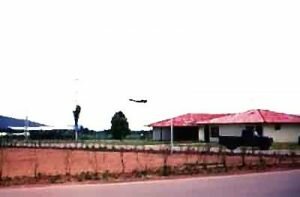 The buddy flight departure required coordination with the area combat support commander to schedule departure during a period of least observance and between takeoff of combat craft and their return. The return flight would have to avoid high traffic density and minimize other aircraft’s opportunity to observe the Oxcart vehicle in flight.
Heavy cirrus, ice, and CB activity on both return routes became a factor. Article 131 would travel within a cell with a KC-135 carrying the PF-1 fuel, bringing enough to make an emergency landing in South Vietnam if needed. Article 131 would identify as a KC-135 on buddy flight, with F-105’s from Takhli escorting the cell to a point near Saigon where F-4’s would take up the escort mission to a safe point off-shore South Vietnam.
There was no need for a pressure suit on the low altitude return flight, so Murray used a summer flying suit and his regular flying helmet that the-135, recovery crew had brought from Kadena. One can only imagine the people gawking as Murray, his KC-135, and F-105 escorts took the runway for departure. Everybody on the base knew there was a Blackbird there, and when the commotion started with the Buicks running, they lined the taxiways. After the buddy flight’s liftoff, the Agency security people went crazy trying to round up the cameras on base.
As the weather worsened, Murray and the tanker pilot decided that the KC-135 would be the buddy flight leader, using its radar to vector the flight around the weather cells. Sometimes on the flight back, the  tanker would lead, and other times Murray led the flight. They had to avoid the storms and a B-52 Arc Lite flight in Philippine air space as well. The return, made at 30,000 feet, required three aerial refuelings of Murray’s A-12. The INS worked well with no updates on the return. When Murray landed back at Kadena, the INS was within spec for position and ground speed. Not bad after the crude start made hours before at Takhli.
Murray had flown at Mach 3.19 and 81,000 feet for 2:20 hours before aborting. The imagery quality was good.
 Murray’s buddy flight back to Kadena lasting over 5 hours established recovery procedures that became part of the TAC doctrine.
The CIA’s wandering boy returned to Kadena with a sore butt, credit for half a mission, and a couple of interesting side stories of things that happened along the way.
The first occurred after a couple of days of Murray lounging around the U-2 compound when he asked to borrow some civilian clothing to go to the Officer’s Club on the base. The U-2 detachment people were not fond of that idea but said OK so long as one of their security people went along. So off they went to get a beer.
They were sitting at the bar when Murray felt a tap on the shoulder. Turning to see who did the tapping,  Murray was surprised to see an old friend from the 60th Fighter-Interceptor Squadron; the unit Murray came from to go to Area 51 and the Oxcart Program. The old friend asked what Murray was doing at Takhli, so Murray told him he was a Hughes Tech Rep, working on a radar system in the vicinity. The friend exchanged chit-chat and went his way. Sometime later, after Murray got back in the Air Force, he was sent to a refresher course on Sea Survival at Tyndall AFB in Florida. At this school, the old friend found Murray once again, this time as a Lt Col in the Air Force. Murray told him that he just decided to get back in the Blue Suit. The old friend said something about doubting anything Murray said, quipping that he must have been the guy that flew the Blackbird into Takhli back in ’67. Murray could not confirm anything since the Program was still classified. One can see why the Agency guys didn’t want Murray to go to the Club at Takhli.
The second exciting event was the effect of having seen Murray and his A-12 in a combat zone. The security guys had the Vice Wing Commander of the F-105 fighter squadron sign a paper where he was required to uphold the Oxcart operation’s security, effectively ending the colonel’s combat flying in that war.
Ironically, the Wing Commander was Colonel John Giraudo, whose brother Joe had been at Area 51 for some time working for the Agency as a blue suiter on Project OXCART.
This abort mission was one of a kind during the Blackshield operation. All others recovered to Kadena after overflights.
B&N ISBN: 9781987016703
Amazon ISBN-13: 978-1547084876
Smashwords ISBN: 9781370283231
Apple ID 1447815807
402 pages
The combination of the shootdown of the U-2 over Russia in 1960, Russia’s moving into Cuba, and the war in Vietnam placed a heavy load on the Central Intelligence Agency to develop a replacement spy plane, unlike anything the world had ever seen before. The CIA established its station at Area 51 under the CIA’s new Directorate of Science and Technology where it developed America’s first stealth plane, the A-12 Archangel. Designed with slide-rule technology, the CIA produced what is still today the fastest and highest-flying manned air-breathing aircraft ever.
The A-12 plane spent 18 months on a pylon situated on the dry Groom Lake during RCS, radar cross-section evaluations by the CIA’s special projects team at Area 51. It flew 2,850 secret flights out of Area 51 during the flight tests known as Project OXCART. From Area 51, CIA Director Helms deployed people and three planes to a CIA outpost in Kadena, Okinawa where the CIA operationally overflew North Vietnam, Laos, Cambodia, and North Korea during Operation BLACK SHIELD before the Air Force replacing it with the SR-71, the fourth member of the Blackbird family.
Buy and Enjoy
AMAZON
| USA |

No comments yet.